





How to Optimize Your Resume with Keywords from Job Descriptions
The Science of Keyword Matching
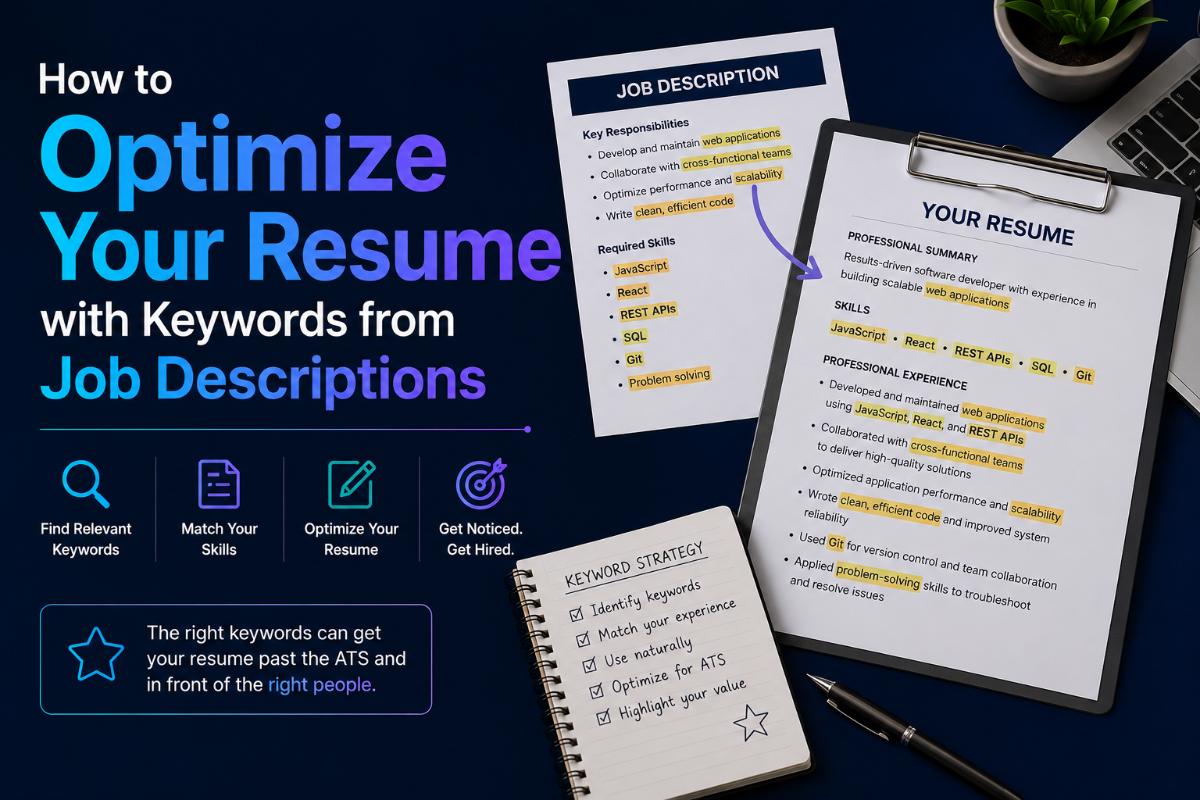
When you submit your resume online, the Applicant Tracking System (ATS) scans the document and matches it against the job description. The system looks for specific technical skills, tools, methodologies, and certifications. If your resume contains these exact words, you score high and move to the recruiter review. If it lacks them, your application is automatically archived. However, many job seekers make the mistake of copy-pasting keywords blindly, which results in disjointed, unreadable resumes.
To stand out, you must learn the science of keyword optimization—identifying the exact terms recruiters want and integrating them naturally into your resume statements.
Step 1: Identify the Core Keywords in a Job Posting
Do not guess what keywords are important. Read the job description carefully and look for:
- Hard Skills / Technical Tools: Frameworks, databases, programming languages, and specialized software (e.g., *"React," "SQL Server," "Figma"*).
- Methodologies: Ways of working (e.g., *"Agile," "Scrum," "CI/CD pipelines," "A/B Testing"*).
- Soft Skills: Collaboration terms (e.g., *"Client communication," "Mentoring," "Cross-functional collaboration"*).
*Tip: Copy the text of the job description into a free **Word Cloud Generator** tool. The words that appear largest in the cloud are the terms that appear most frequently, indicating they are critical keywords.*
Step 2: Place Keywords in Key Sections
Once you have your keyword list, place them strategically across your resume:
- The Skills Section: Group your skills cleanly (e.g., *Frontend: React, JavaScript, HTML5*). This is the easiest area for the parser to scan.
- The Professional Experience Section: Do not just list your daily tasks. Write achievement statements using the keywords. For example, if the job description asks for *"CI/CD pipelines,"* write: *“Designed automated CI/CD pipelines using GitHub Actions, reducing deployment errors by 20%.”*
- The Project Descriptions: Detail the tech stack and frameworks used for each personal project.
Step 3: Avoid Keyword Stuffing
Some candidates try to trick the ATS by pasting keywords in white, invisible fonts at the bottom of the page, or by listing dozens of skills they do not possess. * **Why it fails**: While this might get you past the initial computer scan, the recruiter will see the formatted text as soon as they open the resume. Seeing a list of disjointed keywords with no context leads to instant rejection. Ensure every keyword you use is backed by an achievement statement.
Written by JobPortal Editorial Team
Senior Career Advisor & Recruitment Specialist at JobPortalConnect. With years of experience in HR matching, they review resumes, optimize career pathways, and interview recruiting partners directly.