





The Ultimate Pharma Fresher Interview Guide: Top 13 Basic Q&As
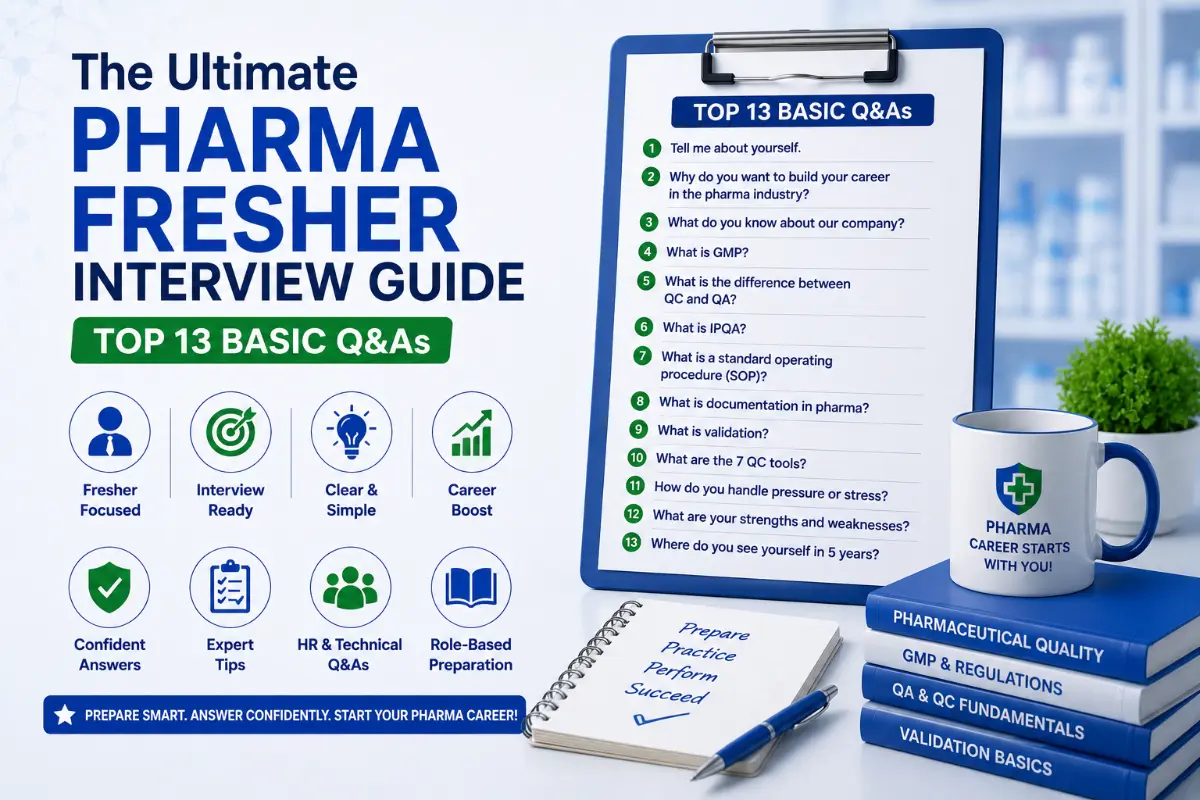
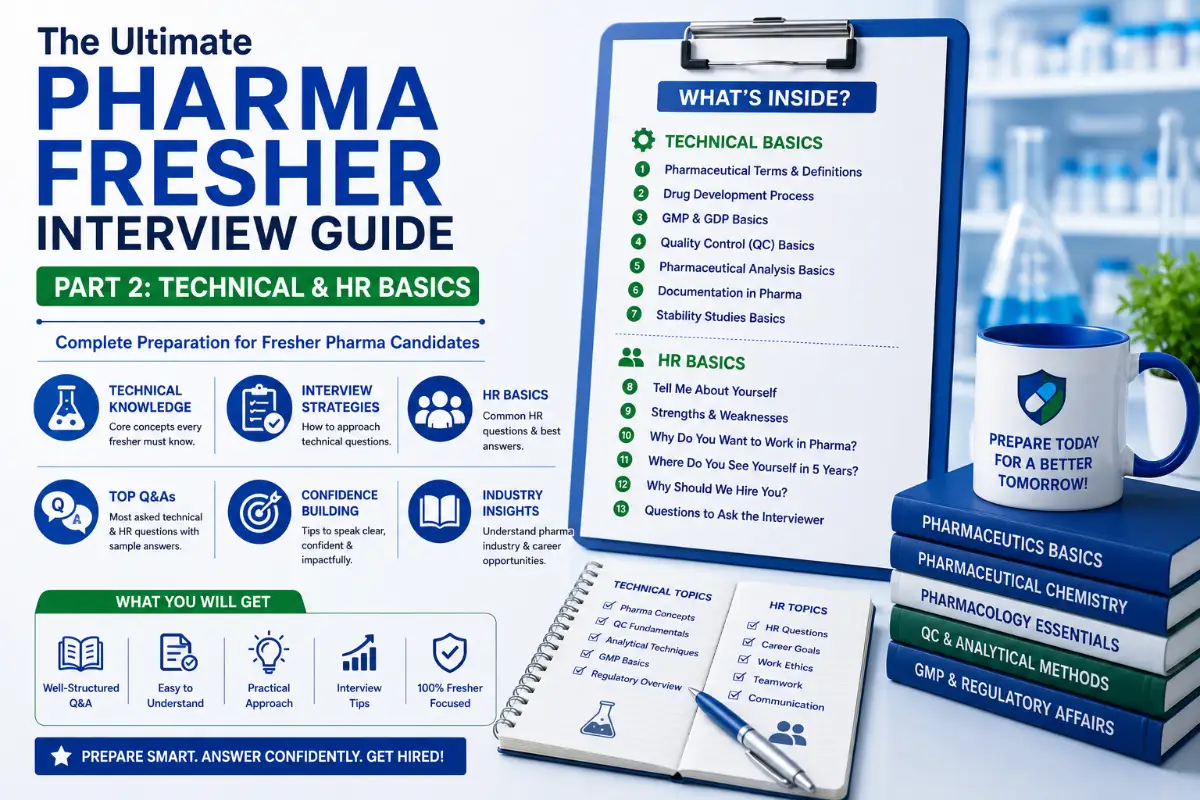
Starting a career in the pharmaceutical industry is a rewarding journey, but passing your first interview as a fresher can be challenging. Interviewers do not expect you to possess years of industrial troubleshooting experience, but they do expect a solid grasp of core concepts—such as dosage forms, GMP standards, and basic pharmacokinetics. Here are the top 13 basic questions and answers tailored to help freshers succeed in their first interview.
Fresher Guide Sections
- 👋 Introductory & Motivation (Q1 - Q2)
- 🏢 Core Industry Terms (Q3 - Q5)
- 💊 Dosage Forms & Formulation (Q6 - Q8)
- 🧪 Pharmacokinetics & Testing (Q9 - Q12)
- 📋 Standard Procedures & SOPs (Q13)
- 💡 Professional Interview Tips for Freshers
👋 Introductory & Motivation
1. Tell me about yourself.
Answer: "Good morning. I have recently completed my degree in Pharmaceutical Sciences. During my academic journey, I gained a strong theoretical understanding of key subjects including pharmaceutics, pharmacology, pharmaceutical chemistry, microbiology, and quality compliance. I also worked on academic lab projects where I developed practical skills in preparing reagents, operating basic lab glassware, and adhering to documentation practices. I am a detail-oriented, quick learner, and I am eager to start my career in the pharmaceutical industry to apply my knowledge in a structured environment."
2. Why do you want to join the pharmaceutical industry?
Answer: "I want to join the pharmaceutical industry because it is a healthcare-driven sector that directly impacts and improves human lives by delivering life-saving medications. Additionally, the industry is highly structured and regulated, which offers freshers a disciplined environment to learn GMP compliance, analytical methodologies, and advanced quality operations."
🏢 Core Industry Terms
3. What is a drug?
Answer: A drug is any chemical substance or compound intended for use in the diagnosis, cure, mitigation, treatment, or prevention of disease in humans or animals, or to alter the physiological structure or function of the body.
4. What is GMP?
Answer: GMP (Good Manufacturing Practice) is a quality system designed to ensure that pharmaceutical products are consistently manufactured and controlled according to strict quality standards. Its core principles include maintaining detailed documentation, ensuring a clean and hygienic facility, employing qualified and trained personnel, and performing regular quality control checks.
5. What is the difference between QA and QC?
Answer:
- QA (Quality Assurance) is process-oriented and proactive. It focuses on preventing defects through design, writing guidelines (SOPs), conducting audits, and ensuring compliance across the system.
- QC (Quality Control) is product-oriented and reactive. It focuses on identifying defects by testing and analyzing raw materials, packaging materials, in-process samples, and finished products.
💊 Dosage Forms & Formulation
6. What is a tablet?
Answer: A tablet is a solid unit dosage form containing an Active Pharmaceutical Ingredient (API) blended with excipients, manufactured by compressing the powdered blend using specialized tablet presses.
7. What are excipients? Give examples.
Answer: Excipients are inactive substances formulated alongside the active ingredient of a medication. They are added to facilitate manufacturing, improve stability, adjust taste, or aid absorption. Examples: Binders (gelatin, starch), Disintegrants (crosscarmellose sodium), Lubricants (magnesium stearate), and Preservatives (methylparaben).
8. What is an API?
Answer: API stands for Active Pharmaceutical Ingredient. It is the biologically active chemical compound in a drug product that is responsible for producing the intended therapeutic or pharmacological effect (e.g. Paracetamol is the API in a pain relief tablet).
🧪 Pharmacokinetics & Testing
9. What is bioavailability?
Answer: Bioavailability is the rate and extent at which the active drug ingredient is absorbed from a dosage form and becomes available in the systemic circulation to produce its therapeutic effect (IV drugs have 100% bioavailability).
10. What is the half-life of a drug?
Answer: The half-life ($t_{1/2}$) of a drug is the time required for the total concentration of the drug in the body or bloodstream to decrease by exactly 50% of its initial value through metabolic or excretory processes.
11. What is dissolution?
Answer: Dissolution is the process by which a solid dosage form disintegrates and its active ingredient dissolves into a liquid medium, turning into a solute in solution, which is a prerequisite for absorption in the body.
12. What is stability testing?
Answer: Stability testing is the systematic evaluation of how the physical, chemical, and microbiological quality of a drug product changes over time under the influence of environmental factors such as temperature, humidity, and light. It is used to determine shelf life and expiration dates.
📋 Standard Procedures
13. What is an SOP?
Answer: An SOP (Standard Operating Procedure) is a formally written, approved document that provides detailed, step-by-step instructions to perform a specific routine activity (e.g. cleaning a balance, preparing a buffer). SOPs ensure that processes are carried out consistently and in compliance with GMP guidelines.
💡 Professional Interview Tips for Freshers
- Highlight Academics: If you lack industry experience, talk about your lab classes, analytical instrumentation theory, and your final year project.
- Show GMP Awareness: Emphasize your understanding of data integrity, contemporaneous recording, and following written SOPs. This tells HR you are low-risk.
- Be Honest: If you do not know the answer to a technical question, do not guess. Say: "I haven't studied that concept in detail yet, but I am quick to learn and will read up on it."
Written by Senior Academic Counselor & HR Partner
Senior Career Advisor & Recruitment Specialist at JobPortalConnect. With years of experience in HR matching, they review resumes, optimize career pathways, and interview recruiting partners directly.