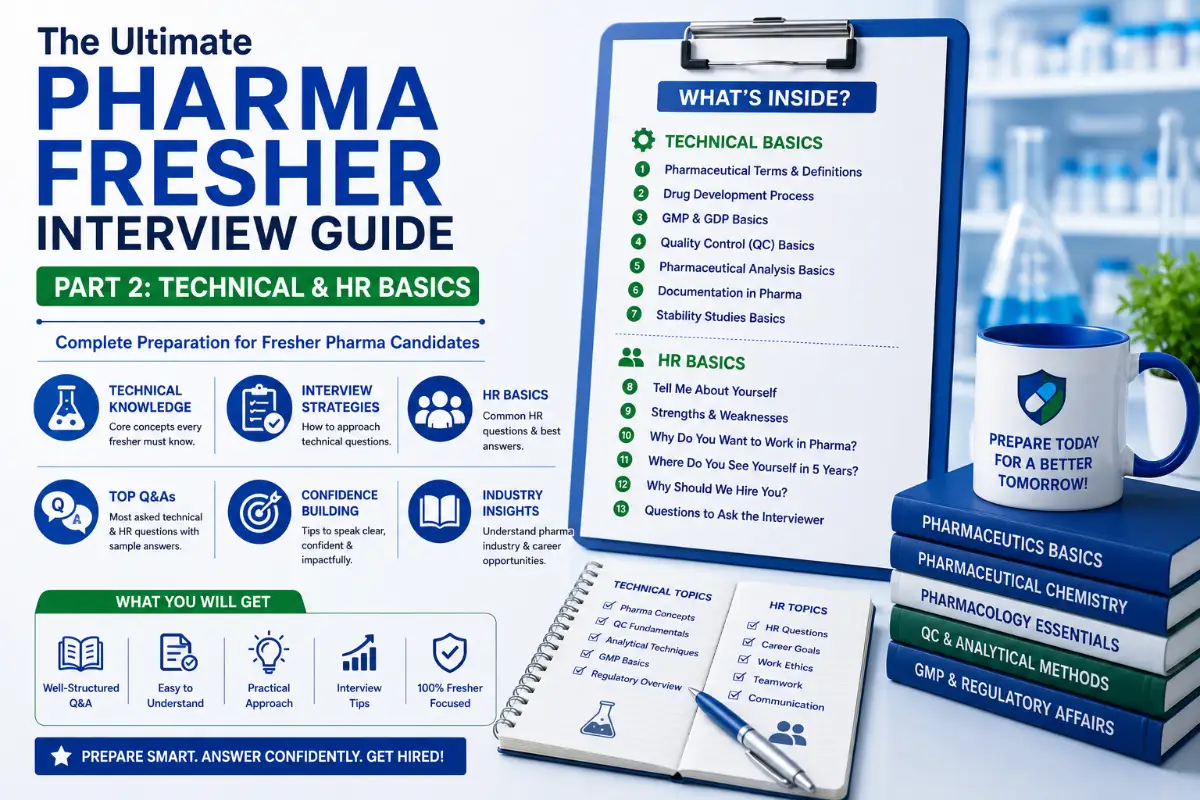






Pharmaceutical QC Written Exam Question Bank – Part 4: Behavioral & Technical Prep
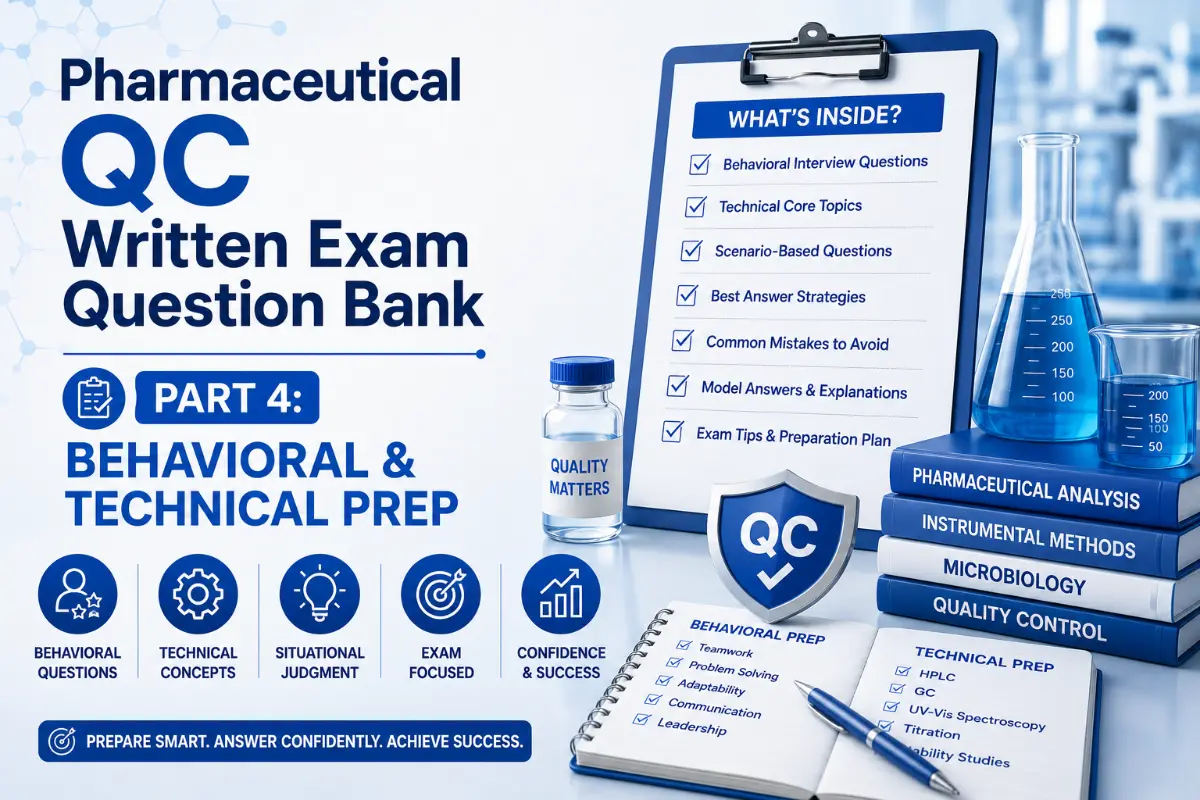
Welcome to Part 4 of the Ultimate Pharmaceutical Quality Control preparation guide. While technical knowledge of chromatography and calculations is critical, QC hiring panels evaluate candidates on how they communicate, how they handle high-pressure deadlines, and how they implement documentation and laboratory safety culture. Below are 24 of the most frequently asked QC behavioral and advanced technical interview questions with detailed, structured sample answers.
Part 4 Sections
- 👋 Introductory & Departmental Setup (Q1 - Q4)
- 🔬 Advanced Technical Concepts (Q5 - Q14)
- 📋 Compliance, Deviations & OOS (Q15 - Q20)
- 💼 Practical Operations & Behavioral Q&A (Q21 - Q24)
👋 Introductory & Departmental Setup
1. Tell me about yourself.
Answer: "I hold a degree in Pharmacy (B.Pharm), where I built a solid foundation in organic chemistry, pharmacology, and pharmaceutical analysis. During my academic projects, I gained hands-on experience preparing reagents, conducting titrations, and running basic UV-Vis spectroscopy. I have a strong attention to detail and have thoroughly studied GMP guidelines, data integrity principles, and pharmacopoeial methods (USP/BP). I am eager to start my career in a Quality Control role where I can apply my analytical skills and help maintain your facility's high compliance standards."
2. What is Quality Control in Pharmaceuticals?
Answer: Quality Control (QC) is the analytical division of pharmaceutical operations. It is concerned with sampling, setting specifications, and executing chemical/microbiological testing. QC ensures that raw materials, packaging materials, intermediates, and final drug products meet established standards of identity, strength, quality, and purity before they are authorized for manufacturing use or commercial sale.
3. What are the responsibilities of a QC Analyst?
Answer: Key duties include: safely sampling and testing raw materials, packaging components, and finished batches; preparing reagents and standardizing volumetric solutions; operating and maintaining laboratory instruments (HPLC, GC, UV-Vis, dissolution baths); completing laboratory logs, notebooks, and analytical worksheets contemporaneously following data integrity rules; reporting OOS/OOT results immediately; and adhering to laboratory safety practices.
4. What are the different departments in QC?
Answer: Pharmaceutical Quality Control is typically divided into: **Raw Material (RM) Section**, **Finished Product (FP) Section**, **Stability Testing Section**, **Microbiology Lab**, **Instrumentation Section**, and **Wet Chemistry/Physicochemical Lab**.
🔬 Advanced Technical Concepts
5. What is GLP? Why is it important?
Answer: Good Laboratory Practice (GLP) is a quality system governing the organizational processes and conditions under which non-clinical health and safety studies are planned, performed, monitored, recorded, archived, and reported. It is important because it ensures the generation of high-quality, reliable, and reproducible laboratory test data, which forms the basis for regulatory product approvals.
6. What is GMP? How does it differ from GLP?
Answer: **GMP** (Good Manufacturing Practice) regulates the entire commercial manufacturing process, packaging, and storage of drug products to ensure consistency and quality. **GLP** (Good Laboratory Practice) regulates the safety testing, non-clinical research, and laboratory trials phase. GMP focuses on plant operations and preventing cross-contamination in batch runs; GLP focuses on study integrity and laboratory organization.
7. What are the different types of errors in analysis?
Answer: Analysis errors are classified into:
- Systematic (Determinate) Errors: Consistent, reproducible errors caused by instrument calibration drift, analyst bias, or method flaws. They can be identified and corrected.
- Random (Indeterminate) Errors: Uncontrollable, accidental fluctuations that cannot be completely eliminated. They are evaluated using statistical analysis.
8. What is method validation? List its parameters.
Answer: Method Validation is the process of providing documented evidence that an analytical test procedure is accurate, reliable, reproducible, and suitable for its intended chemical assay. Parameters evaluated (per ICH Q2(R1)) include: Accuracy, Precision, Specificity, Linearity, Range, Detection Limit (LOD), Quantitation Limit (LOQ), and Robustness.
9. What is calibration? Why is it necessary?
Answer: Calibration is the comparison of an instrument's measurements against a known, traceable reference standard of verified accuracy. It is necessary to ensure the instrument is performing correctly, eliminate measurement bias, and guarantee the scientific validity of laboratory testing.
10. What is the use of a standard? How do you prepare it?
Answer: A standard of known concentration is used to calibrate instrumentation and serve as a reference point to calculate analyte concentrations in samples. Standard preparation involves weighing a precise mass of standard substance on an analytical balance, dissolving it in a chosen solvent, and diluting to the mark in a certified volumetric flask.
11. What is system suitability testing? Why is it performed?
Answer: System Suitability Testing (SST) is the injection of reference standard replicates before sample analysis to verify that the chromatography system, column, detector, and mobile phase are functioning properly. It is performed to guarantee that test results are valid and reproducible.
12. What is LOD and LOQ?
Answer: **LOD (Limit of Detection)** is the lowest concentration of analyte in a sample that can be detected but not necessarily quantified. **LOQ (Limit of Quantitation)** is the lowest concentration that can be quantitatively determined with acceptable accuracy and precision.
13. What is the difference between Precision and Accuracy?
Answer: **Accuracy** is the closeness of agreement between the measured test value and the accepted true value. **Precision** is the degree of agreement (closeness) among individual replicate measurements under the same test conditions, regardless of whether they are accurate.
14. What is the difference between Verification and Validation?
Answer: **Verification** is checking whether a system or product complies with its defined specifications (e.g. verifying that a standard operating procedure was followed). **Validation** is confirming that a process, method, or system consistently achieves its intended performance outcome (e.g. process validation).
📋 Compliance, Deviations & OOS
15. How do you ensure data integrity in the laboratory?
Answer: By strictly adhering to ALCOA+ principles: ensuring all test actions are recorded immediately (contemporaneous), signed by the analyst (attributable), printed directly from software (original), and preserved in secure databases with restricted admin permissions and active audit trails.
16. What is a deviation? How do you handle it?
Answer: A deviation is an unplanned departure from an approved SOP or manufacturing process. It is handled by: halting the affected process, notifying the supervisor, documenting the deviation in the log, conducting a root-cause investigation, and implementing Corrective and Preventive Actions (CAPA).
17. What is OOS result? What steps do you follow?
Answer: Out of Specification (OOS) is an analytical test result that falls outside established specifications or pharmacopoeial limits. Steps:
1. Immediately inform the supervisor.
2. Do not discard any solutions or standard preparations.
3. Initiate a Phase I laboratory investigation (inspect glassware, check calculations, verify instrument calibration).
4. If a clear laboratory error is found, document it and invalidate the test. If no laboratory error is found, initiate a Phase II manufacturing investigation.
18. What is change control?
Answer: Change Control is a formal process for proposing, reviewing, evaluating, and authorizing any modification to plant equipment, processes, software, or raw material suppliers to ensure product quality and regulatory compliance remain uncompromised.
19. What is a CAPA?
Answer: Corrective and Preventive Action. **Corrective Action** is action taken to resolve an active quality deviation. **Preventive Action** is action taken to improve processes or equipment to prevent similar deviations from occurring in the future.
20. What is stability testing? Why is it important?
Answer: Stability testing is the program of storing drug substances or products under controlled temperature and humidity conditions over time to evaluate how their quality changes. It is important because it establishes shelf life, expiration dates, and appropriate label storage conditions.
💼 Practical Operations & Behavioral Q&A
21. Have you worked with HPLC/GC/UV/IR/AAS/Dissolution? Briefly explain.
Answer: "Yes, during my coursework and training, I operated UV-Vis spectrophotometers for content uniformity tests, dissolution baths to evaluate tablet dissolution rates, and studied HPLC peak integrations. I understand mobile phase prep, column conditioning, and detector calibrations."
22. How do you maintain your instruments?
Answer: By strictly adhering to instrument SOPs: performing daily checks (baseline noise, temperature, flow checks), washing HPLC columns post-analysis, covering optics on spectrophotometers, logging all usage in instrument diaries, and ensuring calibrations are performed at scheduled frequencies.
23. How do you prepare a QC analytical report?
Answer: By summarizing all raw data, including sample details, batch numbers, analytical method references, standard and sample weights, peak areas or titration volumes consumed, final assay calculations, and matching them against specification limits. The report must be reviewed and signed by the analyst, then sent to a supervisor for secondary review.
24. How do you handle high pressure situations or tight deadlines?
Answer: "I handle high pressure by prioritizing my tasks. First, I identify the most critical batches requiring testing. I plan my standard and sample preparations systematically to maximize instrument runtimes. I remain calm, stick strictly to SOPs, and never skip documentation steps, since rushing in a GMP environment leads to documentation errors and deviations."
25. Why do you want to work in QC?
Answer: "I want to work in QC because I enjoy the scientific discipline of laboratory testing. In QC, I can apply analytical chemistry to protect patient safety directly. Every test I run helps ensure that the medicine distributed to pharmacies and hospitals is of the highest quality."
Written by Lead QC Trainer & Senior Analyst
Senior Career Advisor & Recruitment Specialist at JobPortalConnect. With years of experience in HR matching, they review resumes, optimize career pathways, and interview recruiting partners directly.