





Pharmaceutical QC Written Exam Question Bank – Part 2: Calculations & Engineering
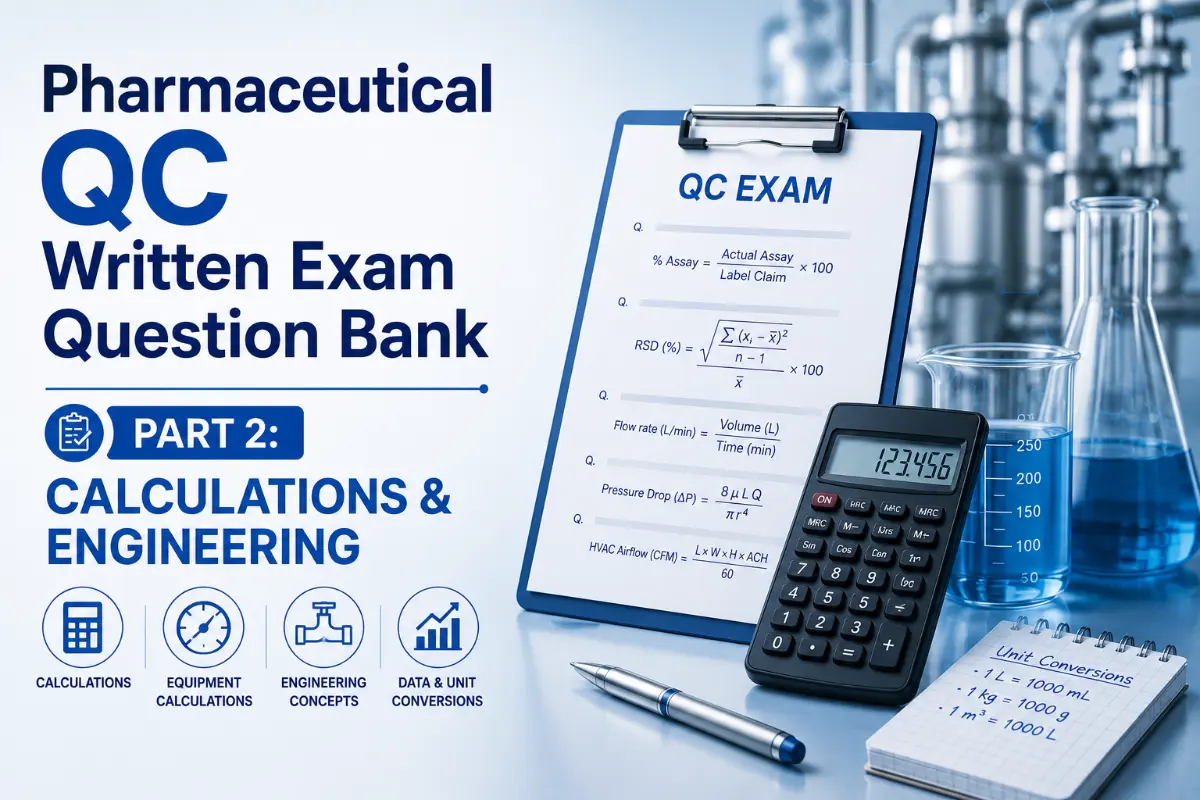
Welcome to Part 2 of the Ultimate Pharmaceutical Quality Control written exam preparation guide. In this installment, we shift our focus from chemical theory and chromatography to the critical operational areas: mathematical calculations, cleanroom standards, HVAC systems, industrial water loops (PW/WFI), and utility qualification. Below are 44 core technical questions complete with detailed, regulatory-compliant answers.
Part 2 Sections
- 📊 Mathematics & Calculations (Q1 - Q14)
- 💨 Clean Room & HVAC Systems (Q15 - Q29)
- 💧 Pure Water Systems (Q30 - Q36)
- 🛠️ Utilities & Engineering (Q37 - Q44)
📊 Mathematics & Pharmaceutical Calculations
1. Define Molarity, Molality, Normality. Write the formula.
Answer:
- Molarity (M): $\text{Molarity} = \frac{\text{Moles of solute (g)}}{\text{Volume of solution (L)}}$
- Molality (m): $\text{Molality} = \frac{\text{Moles of solute (g)}}{\text{Weight of solvent (kg)}}$
- Normality (N): $\text{Normality} = \frac{\text{Gram equivalents of solute (eq)}}{\text{Volume of solution (L)}}$
2. Differentiate between Molarity, Molality and Normality.
Answer: Molarity and Normality are temperature-dependent because volume changes with temperature, whereas Molality is temperature-independent because it measures mass. Normality is equivalent-weight specific (taking ionic charge/valence into account), making it reaction-specific, while molarity depends solely on molecular weight.
3. Calculate the molarity of a solution containing 58.5 g NaCl in 1 L solution.
Answer: Molecular weight of NaCl = $58.44\text{ g/mol}$ (approx $58.5\text{ g/mol}$).
$\text{Moles of NaCl} = 58.5\text{ g} / 58.5\text{ g/mol} = 1.0\text{ mole}$.
$\text{Molarity} = 1.0\text{ mole} / 1\text{ L} = \mathbf{1.0\text{ M}}$.
4. Calculate the normality of 4.9 g $H_2SO_4$ in 1 L solution.
Answer: Molecular weight of $H_2SO_4$ = $98.08\text{ g/mol}$. Valence factor of $H_2SO_4$ = 2.
$\text{Equivalent weight} = 98.08 / 2 = 49.04\text{ g/eq}$.
$\text{Gram equivalents} = 4.9\text{ g} / 49.04\text{ g/eq} = 0.1\text{ eq}$.
$\text{Normality} = 0.1\text{ eq} / 1\text{ L} = \mathbf{0.1\text{ N}}$.
5. Calculate the molality of a solution containing 10 g NaOH in 100 g water.
Answer: Molecular weight of NaOH = $40.0\text{ g/mol}$. Solvent mass (water) = $100\text{ g} = 0.1\text{ kg}$.
$\text{Moles of NaOH} = 10\text{ g} / 40\text{ g/mol} = 0.25\text{ moles}$.
$\text{Molality (m)} = 0.25\text{ moles} / 0.1\text{ kg} = \mathbf{2.5\text{ m}}$.
6. Convert % w/v to mg/mL, and mg/mL to ppm.
Answer:
- % w/v to mg/mL: Multiply by 10 (e.g. $1\%\text{ w/v} = 1\text{ g}/100\text{ mL} = 1000\text{ mg}/100\text{ mL} = 10\text{ mg/mL}$).
- mg/mL to ppm: Multiply by 1000 (e.g. $1\text{ mg/mL} = 1000\text{ mg/L} = 1000\text{ ppm}$).
7. Calculate dilution using $C_1V_1 = C_2V_2$.
Answer: To find the required volume ($V_1$) of a concentrated stock solution ($C_1$) needed to prepare a specific volume ($V_2$) of a diluted solution ($C_2$), use $V_1 = (C_2 \times V_2) / C_1$. For example: to make 100 mL of 0.1N NaOH from a 1N stock, $V_1 = (0.1 \times 100) / 1 = 10\text{ mL}$.
8. Calculate assay percentage from given chromatographic data.
Answer: $\text{Assay \%} = \frac{\text{Sample Area}}{\text{Standard Area}} \times \frac{\text{Standard Weight}}{\text{Sample Weight}} \times \frac{\text{Sample Dilution}}{\text{Standard Dilution}} \times \text{Purity of Standard} \times 100$.
9. Calculate Relative Standard Deviation (RSD) and Recovery percentage.
Answer:
- % RSD: $\text{\% RSD} = (\text{Standard Deviation} / \text{Mean}) \times 100$. Used to measure precision.
- % Recovery: $\text{\% Recovery} = (\text{Amount found} / \text{Amount added}) \times 100$. Used to evaluate method accuracy.
10. Calculate LOD and LOQ from standard deviation and slope.
Answer: Based on the calibration curve:
- $\text{LOD (Limit of Detection)} = 3.3 \times (\sigma / S)$
- $\text{LOQ (Limit of Quantitation)} = 10 \times (\sigma / S)$
(where $\sigma$ is the standard deviation of response, and $S$ is the slope of the calibration curve).
11. Calculate potency correction factor and equivalent weight.
Answer:
- Potency Correction Factor: $\text{Correction Factor} = 100 / \text{Potency on As-Is Basis (\%)}$ (or adjusting weights as: $\text{Weight to take} = \text{Target Weight} \times (100 / \text{Potency})$).
- Equivalent Weight: $\text{Equivalent Weight} = \text{Molecular Weight} / \text{Valence Factor (n)}$.
12. Calculate molecular weight from chemical formula.
Answer: Sum the individual atomic weights of all constituent elements in the formula. Example: For water ($H_2O$): $(2 \times 1.008) + (1 \times 15.999) = 18.015\text{ g/mol}$.
13. Calculate concentration after serial dilution.
Answer: Multiply the starting concentration by the dilution ratio of each step. For example, diluting 1 mL of 1000 mg/L stock to 10 mL (Step 1: 1:10) and then diluting 1 mL of that to 50 mL (Step 2: 1:50) results in: $1000\text{ mg/L} \times (1/10) \times (1/50) = 2\text{ mg/L}$.
14. What is titer value?
Answer: The mass of a target chemical analyte that reacts stoichiometrically with exactly 1.0 mL of a standardized volumetric titrant solution.
💨 Clean Room & HVAC
15. What is a clean room? Why is it required in pharmaceutical manufacturing?
Answer: A cleanroom is an engineered environment with controlled levels of airborne particulate contamination (dust, microbes, particles), temperature, humidity, and differential pressure. It is required to prevent contamination and cross-contamination of sterile drugs, ensuring patient safety.
16. What are the different clean room grades?
Answer: According to EU GMP, cleanrooms are classified into four grades: **Grade A** (High-risk operations, aseptic filling), **Grade B** (Background environment for Grade A), **Grade C** (Less critical sterile preparation steps), and **Grade D** (Least critical tasks, handling components post-washing).
17. Differentiate between Grade A, B, C, and D areas.
Answer: The difference lies in the maximum allowable limits of airborne particles (at rest vs in operation) and microbial counts (viable counts). Grade A is the cleanest (laminar airflow, 0 viable colonies, $< 3,520$ particles $\geq 0.5 \mu m$ in operation), while Grade D has the highest allowable limits.
18. What is ISO classification of clean rooms?
Answer: ISO 14644-1 classifies cleanrooms based on airborne particulate concentrations per cubic meter of air, ranging from ISO 1 (cleanest) to ISO 9 (dirtiest). In pharma, ISO 5 to ISO 8 classes are primarily used.
19. Differentiate between EU GMP Grade A and ISO Class 5.
Answer: EU GMP Grade A represents the highest grade of pharmaceutical cleanliness and requires laminar airflow (0.45 m/s) and strict monitoring for both viable microbes (0 cfu) and non-viable particles. ISO Class 5 is a general engineering standard for particle counts ($3520$ particles $\geq 0.5 \mu m/m^3$) but does not dictate sterile microbiological parameters or specific air flow directions.
20. What is HEPA filter? ULPA filter? Laminar Air Flow (LAF)?
Answer:
- HEPA (High-Efficiency Particulate Air): Filters that remove at least 99.97% of particles $\geq 0.3 \mu m$.
- ULPA (Ultra-Low Penetration Air): Filters that remove 99.999% of particles $\geq 0.12 \mu m$.
- LAF (Laminar Air Flow): Unidirectional, non-turbulent air flowing in parallel lines to sweep away contamination.
21. What is Air Change Per Hour (ACPH)?
Answer: The number of times the total volume of air within a cleanroom is completely replaced by filtered air in one hour. Typical cleanrooms require 20 to 60 ACPH depending on grade.
22. What is Differential Pressure?
Answer: The difference in static air pressure between two adjacent rooms or spaces. It is measured in Pascals (Pa) or inches of water column.
23. Why is pressure differential maintained in clean rooms?
Answer: To establish positive pressure cascades (usually 10-15 Pa difference) ensuring air flows *out* of cleaner rooms to dirtier rooms, preventing contaminated air from entering high-cleanliness areas when doors are opened.
24. What is temperature and humidity control in clean rooms?
Answer: Maintenance of cleanrooms at specific ranges (typically 20-22°C and 30-45% RH) to inhibit bacterial growth, prevent operator sweating, and maintain the chemical stability of moisture-sensitive materials.
25. What is HVAC? What are the components of an HVAC system?
Answer: Heating, Ventilation, and Air Conditioning system. Components: Air Handling Unit (AHU), dehumidifiers, pre-filters, HEPA filters, ducting, dampers, and return air risers.
25b. What is cross-contamination? How can it be prevented?
Answer: The contamination of a starting material, intermediate, or finished product with another material or product. Prevented by using dedicated facilities (for sensitizing substances like Penicillins), differential air pressures, HEPA filtration, proper line clearance, and cleaning validation.
26. What is environmental monitoring?
Answer: The testing and tracking program (microbiological settle plates, active air samplers, swab checks, and particle counters) used to verify that cleanrooms maintain their certified level of control.
27. What is viable and non-viable particle monitoring?
Answer:
- Viable Monitoring: Counts living microbial organisms (bacteria, fungi) using culture media plates.
- Non-Viable Monitoring: Counts total airborne dust/suspended particles using laser particle counters.
28. What is smoke study?
Answer: A visualization test using a visible neutral smoke generator to confirm unidirectional air flow patterns, evaluate turbulence zones, and map airflow around critical machinery under dynamic conditions.
29. What is media fill test?
Answer: A process simulation test where a sterile microbiological growth medium (e.g. soybean casein digest medium) is processed through the normal assembly line instead of the drug, to verify the sterility assurance level of the aseptic filling process.
💧 Water System
30. What is Purified Water (PW)?
Answer: Water prepared from potable source water by filtration, deionization, reverse osmosis, or distillation. Used as excipient in non-sterile formulations and for washing non-sterile equipment.
31. What is Water for Injection (WFI)?
Answer: High-purity water intended for use in parenteral (injectable) formulations. It must be prepared by distillation or reverse osmosis and must be pyrogen-free (no endotoxins).
32. Differentiate between PW and WFI.
Answer: WFI has much stricter conductivity ($< 1.3\text{ }\mu S/cm$ at 25°C), TOC ($< 500\text{ ppb}$), and microbial limits ($< 10\text{ cfu/100mL}$ compared to PW's $< 100\text{ cfu/mL}$), and WFI has an absolute endotoxin limit ($< 0.25\text{ EU/mL}$) while PW does not.
33. What is conductivity of purified water?
Answer: A measure of ionic impurities in the water. USP Stage 1 conductivity limit for purified water is **$< 1.3\text{ }\mu S/cm$ at 25°C**.
34. What is TOC?
Answer: Total Organic Carbon. Measures the quantity of organic molecules covalently bound in the water. The USP limit for TOC in PW and WFI is **$< 500\text{ ppb}$ (or $0.5\text{ mg/L}$)**.
35. What is microbial limit for purified water?
Answer: Under USP guidelines, the microbial action limit for Purified Water is **$< 100\text{ CFU/mL}$**.
36. How is WFI produced?
Answer: WFI is produced by distillation (Multi-Effect Distillation / vapor compression distillation) or by double-pass Reverse Osmosis (RO) combined with Electrodeionization (EDI) and Ultrafiltration (UF) systems.
🛠️ Pharmaceutical Engineering & Utilities
37. What is compressed air qualification?
Answer: Testing program verifying that compressed air coming in direct contact with products meets specifications for dew point (moisture content), oil mist content, and particulate/microbial levels.
38. What is steam quality testing?
Answer: Evaluation of clean steam used in autoclaves to ensure it meets requirements for Non-Condensable Gases ($< 3.5\%$), Dryness Fraction ($> 0.9$), and Superheat ($< 25^\circ C$).
39. What is preventive maintenance?
Answer: Scheduled, proactive inspections and maintenance activities performed on equipment to prevent unexpected breakdowns and extend operational lifecycles.
40. What is breakdown maintenance?
Answer: Reactive maintenance tasks performed to repair equipment that has failed or stopped operating unexpectedly.
41. What is calibration frequency?
Answer: The predefined time interval (e.g. every 6 months or 12 months) at which measuring instruments must be re-calibrated against standard reference weights/gauges.
42. What is qualification vs validation?
Answer: **Qualification** applies to equipment, utilities, and systems (static verification, e.g. qualifying a sterilizer). **Validation** applies to the overall manufacturing processes or analytical methods (dynamic verification, e.g. process validation).
43. What is DQ (Design Qualification)?
Answer: The documented verification that the proposed design of the facilities, systems, and equipment is suitable for its intended purpose and complies with GMP standards.
44. What is utility qualification?
Answer: The documented qualification program (IQ, OQ, PQ) executed on critical plant utilities such as HVAC, water loop systems, pure steam, and nitrogen supply to ensure consistent compliance.
Written by Lead QC Trainer & Senior Analyst
Senior Career Advisor & Recruitment Specialist at JobPortalConnect. With years of experience in HR matching, they review resumes, optimize career pathways, and interview recruiting partners directly.